
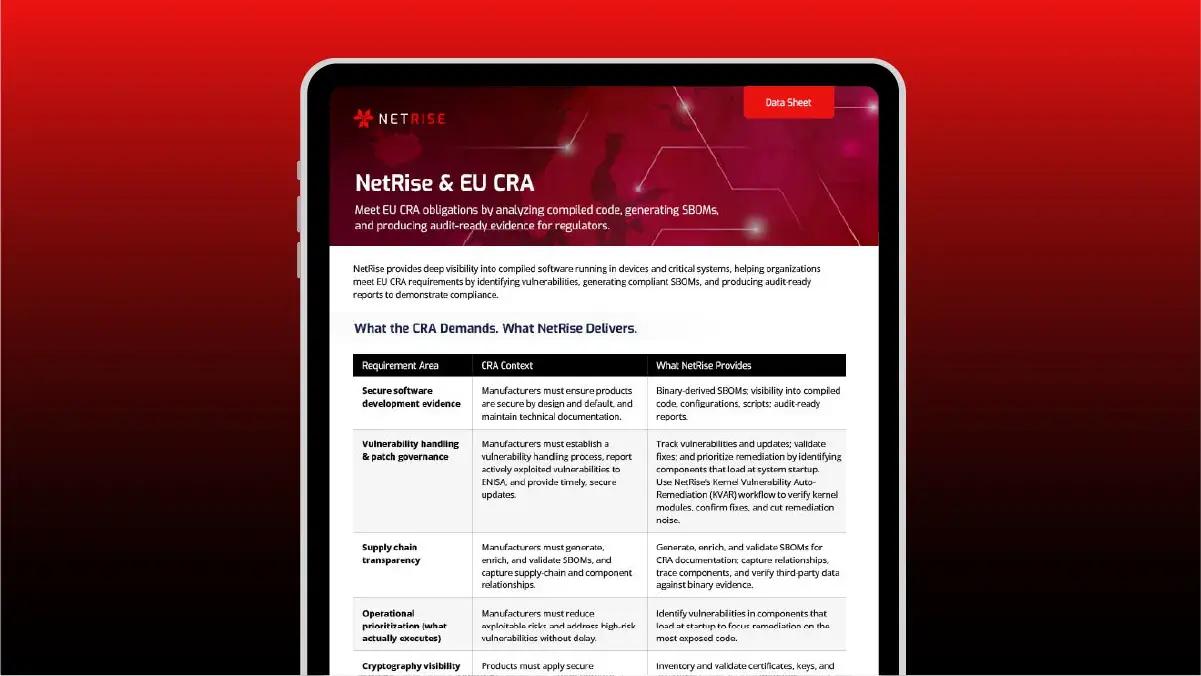
CRA Compliance Report
EU Cyber Resilience Act Assessment • 2025-12-11 22:26
Product Information
Compliance Overview
The EU Cyber Resilience Act (CRA) establishes cybersecurity requirements for products with digital elements. This assessment evaluates compliance across all Annex I requirements.
▶
Part I: Product Security Requirements
11 of 14 clauses assessed
40% Compliant
| Clause | Requirement | Status |
|---|---|---|
| 1 | Appropriate Cybersecurity Level | Partial |
| 2(a) | No Known Exploitable Vulnerabilities | Non-Compliant |
| 2(b) | Secure by Default Configuration | Partial |
| 2(c) | Security Update Capability | Partial |
| 2(d) | Protection from Unauthorized Access | Partial |
| 2(e) | Data Confidentiality | Partial |
| 2(f) | Data Integrity | Partial |
| 2(g) | Data Minimization | Not Assessed |
| 2(h) | Availability Protection | Partial |
| 2(i) | Minimize Network Impact | Partial |
| 2(j) | Limit Attack Surfaces | Partial |
| 2(k) | Exploitation Mitigation | Compliant |
| 2(l) | Security Logging and Monitoring | Not Assessed |
| 2(m) | Secure Data Removal | Not Assessed |
▶
Part II: Vulnerability Handling Requirements
8 of 8 clauses assessed
94% Compliant
| Clause | Requirement | Status |
|---|---|---|
| II-1 | SBOM Documentation | Compliant |
| II-2 | Vulnerability Remediation | Compliant |
| II-3 | Regular Security Testing | Compliant |
| II-4 | Vulnerability Disclosure | Compliant |
| II-5 | Coordinated Vulnerability Disclosure Policy | Compliant |
| II-6 | Vulnerability Information Sharing | Compliant |
| II-7 | Secure Update Distribution | Partial |
| II-8 | Security Update Dissemination | Compliant |
Part I: Product Security Requirements
Assessment Methodology
Checks Performed:
- CISA KEV vulnerabilities present
- Configuration checks failed
- Cracked credentials detected
- Private keys compromised
Score Calculation: Starting from 100 points:
| CISA KEV vulnerabilities (11 found) | -30 pts |
| Config checks failed (5 failed) | -5 pts |
| Cracked credentials (0 found) | No penalty |
| Private keys exposed (30 found) | -20 pts |
| Final Score | 45 pts |
Status Thresholds: ≥80 = Compliant, 25-79 = Partial, <25 = Non-Compliant
| CVE | Severity | KEV | Weaponized | EPSS |
|---|---|---|---|---|
| CVE-2021-0920 | MEDIUM | 🔴 Yes | 💥 Yes | 0.9% |
| CVE-2021-22600 | HIGH | 🔴 Yes | 💥 Yes | 0.2% |
| CVE-2021-3156 | HIGH | 🔴 Yes | 💥 Yes | 92.2% |
| CVE-2022-2586 | HIGH | 🔴 Yes | 💥 Yes | 2.2% |
| CVE-2024-36971 | HIGH | 🔴 Yes | 💥 Yes | 0.4% |
| CVE-2024-50302 | MEDIUM | 🔴 Yes | 💥 Yes | 2.8% |
| CVE-2025-38352 | HIGH | 🔴 Yes | 💥 Yes | 0.2% |
| CVE-2024-1086 | HIGH | 🔴 Yes | 💥 Yes | 86.2% |
| CVE-2024-53197 | HIGH | 🔴 Yes | 💥 Yes | 1.8% |
| CVE-2024-53104 | HIGH | 🔴 Yes | 💥 Yes | 12.0% |
Assessment Methodology
Checks Performed:
- Presence of vulnerabilities on CISA Known Exploited Vulnerabilities (KEV) catalog
- Presence of vulnerabilities with weaponized exploits in the wild
Score Calculation:
| CISA KEV vulnerabilities (11 found) | Immediate Non-Compliance (0 pts) |
| Weaponized exploits (47 found) | N/A (KEV present) |
| Final Score | 0 pts |
Compliance Logic: Any CISA KEV vulnerability results in immediate non-compliance. Weaponized exploits without KEV entries result in partial compliance (30 pts).
Assessment Methodology
Checks Performed:
- Cracked/weak credentials detected (passwords that can be easily broken)
- Critical security configuration checks that failed
- Exposed private keys in firmware/software
Score Calculation: Starting from 100 points:
| Cracked credentials (0 found) | No penalty |
| Critical failed config checks (1 found) | -30 pts |
| Private keys exposed (30 found) | -20 pts |
| Final Score | 50 pts |
Status Thresholds: ≥80 = Compliant, 25-79 = Partial, <25 = Non-Compliant
Assessment Methodology
Checks Performed:
- Vulnerability tracking and identification capability
- Continuous monitoring for new vulnerabilities
Assessment Notes:
NetRise provides vulnerability identification and continuous monitoring capabilities. However, verification of actual update delivery mechanisms requires operational testing outside the scope of static firmware analysis.
Status: Partial - NetRise confirms monitoring capability, but update mechanism verification requires runtime testing.
Assessment Methodology
Checks Performed:
- Cracked/weak credentials that could enable unauthorized access
- Exposed private keys that could compromise authentication
- High volume of critical vulnerabilities indicating access control weaknesses
Score Calculation: Starting from 100 points:
| Cracked credentials (0 found) | No penalty |
| Private keys exposed (30 found) | -20 pts |
| Critical vulns >5 (110 found) | -20 pts |
| Final Score | 60 pts |
Status Thresholds: ≥80 = Compliant, 25-79 = Partial, <25 = Non-Compliant
Assessment Methodology
Checks Performed:
- Certificate validity and configuration issues
- Exposed private keys that could compromise encrypted data
Score Calculation: Starting from 100 points:
| Certificates with issues (2177 found) | -30 pts |
| Private keys exposed (30 found) | -30 pts |
| Final Score | 40 pts |
Status Thresholds: ≥80 = Compliant, 25-79 = Partial, <25 = Non-Compliant
CWEs Checked (13 total)
Access Control: CWE-284, CWE-285, CWE-862, CWE-863, CWE-22
Weak Crypto: CWE-311, CWE-327
Credential Exposure: CWE-798, CWE-522
⚠ 98 vulnerabilities with data integrity CWEs found - Review recommended.
View Matching CVEs (98 total, showing top 10)
| CVE | Severity | Component | CWEs |
|---|---|---|---|
| CVE-2007-2768 | MEDIUM | openssh 7.4 | CWE-200 |
| CVE-2007-4559 | CRITICAL | python 3.8.5 | CWE-22, CWE-22 |
| CVE-2010-4563 | MEDIUM | linux_kernel 5.4.266 | CWE-200 |
| CVE-2017-3736 | MEDIUM | openssl 1.0.2k | CWE-200 |
| CVE-2017-3738 | MEDIUM | openssl 1.0.2k | CWE-200 |
| CVE-2018-0734 | MEDIUM | openssl 1.0.2k | CWE-327 |
| CVE-2018-0737 | MEDIUM | openssl 1.0.2k | CWE-327 |
| CVE-2018-10844 | MEDIUM | gnutls 3.6.8 | CWE-385, CWE-327 |
| CVE-2018-10845 | MEDIUM | gnutls 3.6.8 | CWE-385, CWE-327 |
| CVE-2018-10846 | MEDIUM | gnutls 3.6.8 | CWE-385, CWE-327 |
Assessment Methodology
Checks Performed:
- Scan for 13 data integrity-related CWEs across 4 vulnerability families
- Information Disclosure: CWE-200, CWE-312, CWE-319
- Access Control Failures: CWE-284, CWE-285, CWE-862, CWE-863, CWE-22
- Weak/Missing Crypto: CWE-311, CWE-327
- Credential Exposure: CWE-798, CWE-522
Score Calculation:
| 0 data integrity CWEs | 100 pts (Compliant) |
| 1-5 data integrity CWEs | 70 pts (Partial) |
| 6-15 data integrity CWEs | 50 pts (Partial) |
| >15 data integrity CWEs | 30 pts (Non-Compliant) |
| Current (98 CWE matches) | 30 pts |
Status Thresholds: ≥80 = Compliant, 25-79 = Partial, <25 = Non-Compliant
Indirect coverage through security risk assessment.
Assessment Methodology
Assessment Status: Not Assessed
Data minimization requirements relate to limiting data collection and processing to what is necessary for the product's intended purpose. This is primarily a design and policy consideration that cannot be fully assessed through static firmware analysis.
Indirect Coverage: NetRise can identify potential data leakage risks through vulnerability analysis, but direct assessment of data minimization practices requires design documentation review.
DoS CWEs Checked (12 total)
Algorithmic Complexity: CWE-1333, CWE-834, CWE-606
Hang/Freeze: CWE-835, CWE-674, CWE-1322
Crash-on-demand: CWE-617
⚠ 163 vulnerabilities with DoS-related CWEs found - Review recommended.
View Matching CVEs (163 total, showing top 10)
| CVE | Severity | Component | CWEs |
|---|---|---|---|
| CVE-2012-0876 | MEDIUM | libexpat 1.95.5 | CWE-400 |
| CVE-2017-9233 | HIGH | libexpat 1.95.5 | CWE-835 |
| CVE-2018-0739 | MEDIUM | openssl 1.0.2k | CWE-674 |
| CVE-2018-19591 | HIGH | glibc 2.28 | CWE-20, CWE-404 |
| CVE-2018-20482 | MEDIUM | tar 1.30 | CWE-835 |
| CVE-2018-20796 | HIGH | glibc 2.28 | CWE-674 |
| CVE-2019-15165 | MEDIUM | libpcap 1.9.0 | CWE-770, CWE-770 |
| CVE-2019-19645 | MEDIUM | sqlite 3.26.0 | CWE-674 |
| CVE-2019-3819 | MEDIUM | linux_kernel 5.4.266 | CWE-835, CWE-835 |
| CVE-2019-6488 | HIGH | glibc 2.28 | CWE-404 |
Assessment Methodology
Checks Performed:
- Scan for 12 DoS-related CWEs across 4 vulnerability families
- Resource Exhaustion: CWE-400, CWE-770, CWE-404, CWE-789, CWE-1325
- Algorithmic Complexity (CPU): CWE-1333, CWE-834, CWE-606
- Hang/Freeze: CWE-835, CWE-674, CWE-1322
- Crash-on-demand: CWE-617
Score Calculation:
| 0 DoS-related CWEs | 100 pts (Compliant) |
| 1-3 DoS-related CWEs | 70 pts (Partial) |
| 4-10 DoS-related CWEs | 50 pts (Partial) |
| >10 DoS-related CWEs | 30 pts (Non-Compliant) |
| Current (163 CWE matches) | 30 pts |
Status Thresholds: ≥80 = Compliant, 25-79 = Partial, <25 = Non-Compliant
Assessment Methodology
Checks Performed:
- DoS-related vulnerabilities that could impact network availability
- Critical/High severity vulnerabilities with network impact potential
- Failed security configuration checks
Assessment Notes:
This clause is assessed in conjunction with Clause 2(h) Availability Protection, as DoS vulnerabilities directly impact network service availability.
Score: 30 pts (based on DoS vulnerability assessment)
Status Thresholds: ≥80 = Compliant, 25-79 = Partial, <25 = Non-Compliant
Assessment Methodology
Checks Performed:
- CISA KEV vulnerabilities (actively exploited attack vectors)
- Weaponized exploits (high-risk attack surface exposure)
- Component count (software attack surface size - threshold: 500)
Score Calculation: Starting from 100 points:
| CISA KEV vulnerabilities (11 found) | -30 pts |
| Weaponized exploits (47 found) | -20 pts |
| Large component count (907 components) | -20 pts |
| Final Score | 30 pts |
Status Thresholds: ≥80 = Compliant, 25-79 = Partial, <25 = Non-Compliant
Assessment Methodology
Checks Performed:
- Weak/cracked credentials that facilitate exploitation
- Exposed private keys that could be leveraged in attacks
- Failed security configuration checks that reduce exploit barriers
Score Calculation: Starting from 100 points:
| Weak/cracked credentials (0 found) | No penalty |
| Exposed private keys (30 found) | -20 pts |
| Final Score | 80 pts |
Status Thresholds: ≥80 = Compliant, 25-79 = Partial, <25 = Non-Compliant
Configuration analysis can be customized to verify logging presence.
Assessment Methodology
Assessment Status: Not Assessed
Security logging and monitoring requirements relate to runtime behavior and operational configuration. Static firmware analysis has limited visibility into logging implementations.
Potential Coverage: Custom configuration checks can be developed to identify presence of logging frameworks, syslog configurations, or audit trails in the firmware image.
Configuration analysis can be customized to verify data removal capability.
Assessment Methodology
Assessment Status: Not Assessed
Secure data removal is primarily a functional capability that requires runtime testing to verify. Static analysis cannot confirm data removal procedures are implemented correctly.
Potential Coverage: Custom configuration checks can identify presence of factory reset mechanisms or data wipe utilities in the firmware.
Part II: Vulnerability Handling Requirements
Assessment Methodology
Checks Performed:
- SBOM generation capability (component enumeration)
- Component-to-vulnerability correlation
- Export format support (CycloneDX, SPDX)
Assessment Logic:
Compliant if components are identified (907 found). The SBOM provides complete visibility into 907 software components, with 65 having known vulnerabilities and 842 (92.8%) being clean.
Assessment Methodology
Checks Performed:
- Vulnerability discovery and tracking
- Fix version availability identification
- Continuous monitoring for new vulnerabilities
Assessment Logic:
NetRise provides automated vulnerability discovery, prioritization, and remediation guidance. 4145 vulnerabilities tracked, with 94 having known fixes available.
Assessment Methodology
Checks Performed:
- CI/CD pipeline integration capability
- Continuous security monitoring
- Automated firmware/software analysis
Assessment Logic:
NetRise supports integration into development pipelines for regular security testing. Continuous monitoring ensures new vulnerabilities are identified as they are disclosed.
Assessment Methodology
Checks Performed:
- VEX (Vulnerability Exploitability Exchange) document generation
- Standardized vulnerability disclosure format
- Impact and severity information availability
Assessment Logic:
NetRise supports VEX document generation for standardized vulnerability disclosure. All 4145 identified vulnerabilities include severity ratings, descriptions, and remediation guidance.
Assessment Methodology
Checks Performed:
- VEX document support for coordinated disclosure
- Vulnerability impact assessment capability
- Standardized severity classification (CVSS)
Assessment Logic:
NetRise supports coordinated vulnerability disclosure through VEX document generation, enabling standardized communication with stakeholders about vulnerability status and impact.
Assessment Methodology
Checks Performed:
- Third-party component vulnerability tracking
- Exportable vulnerability reports
- Multiple format support for information sharing
Assessment Logic:
NetRise identifies and tracks 4145 vulnerabilities in third-party components. Reports can be exported in VEX, CycloneDX, and SPDX formats for stakeholder sharing.
Assessment Methodology
Checks Performed:
- Software version tracking across assets
- Patch validation through re-analysis
- Fix version availability detection
Assessment Logic:
NetRise provides version tracking and can validate patches through re-analysis. 94 vulnerabilities have known fix versions identified. Status is Partial as actual update distribution mechanisms require operational verification.
Assessment Methodology
Checks Performed:
- VEX-formatted security advisory generation
- Remediation guidance availability
- Vulnerability prioritization data (EPSS, KEV, CVSS)
Assessment Logic:
NetRise supports VEX document generation for security advisory dissemination. Advisories include severity, impact, fix availability, and prioritization data to help users take appropriate action.
Detailed Findings
Prioritized Vulnerabilities
Vulnerabilities prioritized by exploitability and impact (showing top 20)
| CVE | Severity | Component | Risk Indicators | EPSS |
|---|---|---|---|---|
| CVE-2021-3156 | HIGH | sudo 1.8.25 | 🔴 KEV 💥 Weaponized | 92.2% |
| CVE-2024-1086 | HIGH | linux_kernel 5.4.266 | 🔴 KEV 💥 Weaponized | 86.2% |
| CVE-2024-53104 | HIGH | linux_kernel 5.4.266 | 🔴 KEV 💥 Weaponized | 12.0% |
| CVE-2022-2586 | HIGH | linux_kernel 5.4.266 | 🔴 KEV 💥 Weaponized | 2.2% |
| CVE-2024-53197 | HIGH | linux_kernel 5.4.266 | 🔴 KEV 💥 Weaponized | 1.8% |
| CVE-2024-53150 | HIGH | linux_kernel 5.4.266 | 🔴 KEV 💥 Weaponized | 1.6% |
| CVE-2024-36971 | HIGH | linux_kernel 5.4.266 | 🔴 KEV 💥 Weaponized | 0.4% |
| CVE-2025-38352 | HIGH | linux_kernel 5.4.266 | 🔴 KEV 💥 Weaponized | 0.2% |
| CVE-2021-22600 | HIGH | linux_kernel 5.4.266 | 🔴 KEV 💥 Weaponized | 0.2% |
| CVE-2024-50302 | MEDIUM | linux_kernel 5.4.266 | 🔴 KEV 💥 Weaponized | 2.8% |
| CVE-2021-0920 | MEDIUM | linux_kernel 5.4.266 | 🔴 KEV 💥 Weaponized | 0.9% |
| CVE-2023-38408 | CRITICAL | openssh 8.3 | 💥 Weaponized | 67.1% |
| CVE-2023-38408 | CRITICAL | openssh 7.4 | 💥 Weaponized | 67.1% |
| CVE-2023-38408 | CRITICAL | openssh 8.0 | 💥 Weaponized | 67.1% |
| CVE-2023-38408 | CRITICAL | openssh 7.4 | 💥 Weaponized | 67.1% |
| CVE-2023-38408 | CRITICAL | openssh 7.9 | 💥 Weaponized | 67.1% |
| CVE-2023-38408 | CRITICAL | openssh 8.3 | 💥 Weaponized | 67.1% |
| CVE-2024-23334 | HIGH | aiohttp 3.7.2 | 💥 Weaponized | 93.6% |
| CVE-2024-2961 | HIGH | glibc 2.32 | 💥 Weaponized | 92.9% |
| CVE-2024-2961 | HIGH | glibc 2.28 | 💥 Weaponized | 92.9% |
Configuration Findings
Security configuration checks performed: 20 total
| Check | Result | Severity | Details |
|---|---|---|---|
| Users with no password set | FAIL | CRITICAL | AUTHENTICATION: Disable login or set a password for the specified users. |
| World writable and readable directories outside tmp | FAIL | MEDIUM | CONFIGURATION: Modify the permissions to restrict access to the directories. |
| Services Without Configuration Files | FAIL | LOW | CONFIGURATION: Include config files for the associated services to further secure installation. |
| Weak hash algorithms found | FAIL | MEDIUM | CRYPTOGRAPHY: Replace weak hashing algorithms with stronger algorithms. |
| Insecure URL | FAIL | MEDIUM | DATA: Check individual URL problem descriptions |
| Multiple users with UID 0 | PASS | — | Check passed |
| Overly permissive access to passwd files | PASS | — | Check passed |
| Authorized Key with Matching Private Key | PASS | — | Check passed |
| History file present on disk | PASS | — | Check passed |
| Sudoers file with weak permissions | PASS | — | Check passed |
| Multiple groups with the same Group ID | PASS | — | Check passed |
| Binaries with Memory Corruption Vulnerabilities and Protection Disabled | PASS | — | Check passed |
| Telnet server exists | PASS | — | Check passed |
| SELinux is disabled | PASS | — | Check passed |
| fstab should always have permissions of 0644 | PASS | — | Check passed |
| Insecure services start at boot | PASS | — | Check passed |
| GTFOBins installed with setuid bit enabled can lead to privilege escalation | PASS | — | Check passed |
| One or more compilers exist | PASS | — | Check passed |
| Sudoers file missing | PASS | — | Check passed |
| Cronjobs with weak permissions | PASS | — | Check passed |
Credential Findings
Credentials and password hashes detected in firmware
✓ No password hashes were successfully cracked.
Cryptographic Material
Keys and certificates discovered in firmware
Complete keypairs (matching public and private keys) were found. This means attackers can extract both keys and fully impersonate the device or decrypt its communications.
Embedded private keys can be extracted and used to compromise encrypted communications or impersonate the device.
Recommendations
- Address CISA KEV Vulnerabilities: 11 vulnerabilities are on the CISA Known Exploited Vulnerabilities list. These must be remediated as a priority per Clause 2(a).
- Remediate Weaponized Exploits: 47 vulnerabilities have known weaponized exploits and pose immediate risk.
- Address Failed Configuration Checks: 5 of 20 security configuration checks failed and require remediation.
- Maintain SBOM Documentation: Ensure the Software Bill of Materials is kept current and available in CycloneDX or SPDX format per Part II Clause 1.
- Establish Vulnerability Disclosure Process: Implement VEX document generation for vulnerability disclosure per Part II Clauses 4-6.
- Continuous Monitoring: Enable continuous vulnerability monitoring to detect new threats as they emerge.
Generated by NetRise Platform • 2025-12-11 22:26
This report provides an assessment of CRA compliance based on NetRise platform analysis.